Neck psychosomatics
Neck pain and heaviness are among the most common complaints. Most often it’s the muscles and ligaments that hurt, and it usually goes away within a few weeks.

Updated
What psychosomatics says
In psychosomatics, the neck is linked to how you judge your own mind, and to your sense of fairness. You were treated unfairly, not valued, not thanked. Or you feel stupid: “I won’t manage,” “I don’t understand anything about this.”
For example, your boss demands perfection, and you’re constantly afraid of making a mistake. Suddenly you’re told, “We don’t need you anymore.” You sit at the table with your husband’s relatives and feel like an outsider. Many people notice their neck and the back of their head start aching right in moments like these.
Your neck muscles hold this tension even when you’re not thinking about it. Psychosomatics helps you remember when the pain started and what was going on then. And see where you’re still putting up with unfairness or think of yourself as “not smart enough.”
What it is
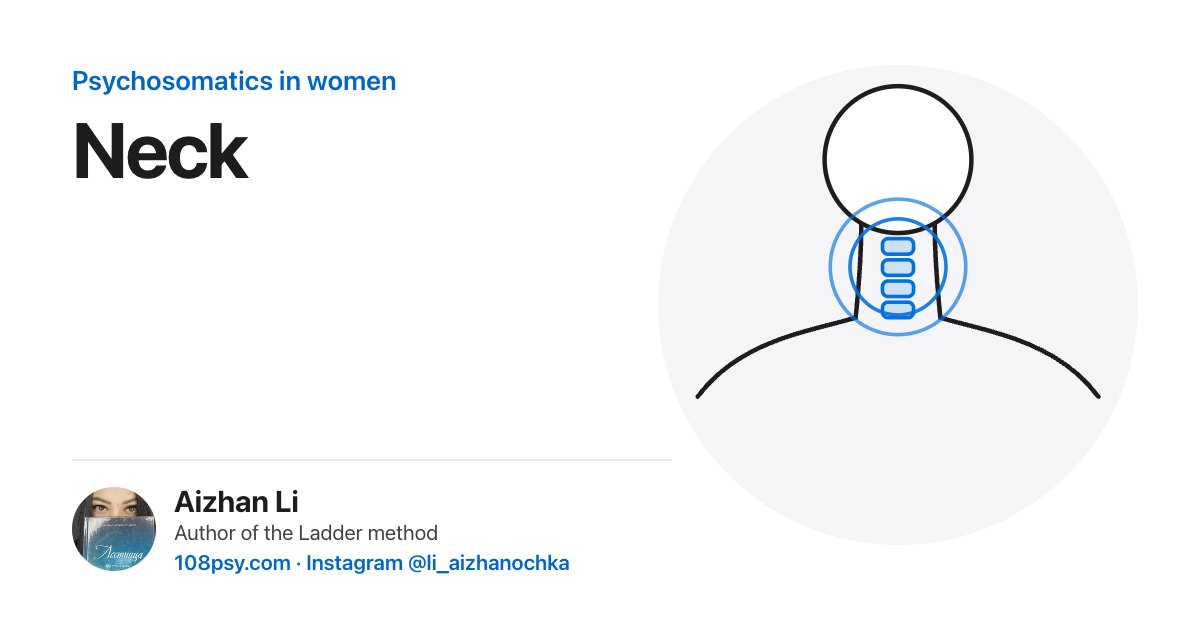
Your neck holds up your head all day. It has vertebrae, discs between them, ligaments and lots of muscles. Most often it’s the muscles that hurt: they get tired and tight if you sit at a computer for a long time, look at your phone or sleep in an awkward position. That’s how the UK’s National Health Service (NHS) lists the causes of pain.
According to WHO (2022), 222 million people worldwide have neck pain. According to the Russian Ministry of Health clinical guidelines (2024), tension-type headache is often linked to tight muscles in the head and neck, and its main triggers are stress and long periods in an awkward position. Women get it slightly more often than men: about 5 to 4.
In everyday speech, almost any neck pain gets called osteochondrosis. Doctors are more precise: neck pain, muscle tension, age-related changes in the discs and joints. Many people over 40 have these changes, and often they don’t hurt at all. The same Russian Ministry of Health guidelines say that changes in the cervical spine on a scan are often wrongly blamed for headaches.
Sometimes a herniated disc or a bone spur presses on a nerve root. Then the pain spreads to the arm, and the arm goes numb, tingles or gets weak. This is called cervical radiculopathy. According to the clinical protocol of the Ministry of Health of Kazakhstan (2017), it’s more often brought on by sitting or standing in one position for a long time, moving too little and lifting heavy things abruptly.
How it shows up
- An aching neck, it’s hard to turn your head
- Stiffness in the morning or after long hours at a computer
- Pain and tension in the shoulders
- A headache that starts at the back of the head
- Pain spreading to the arm
- Tingling or numbness in the arm
A general practitioner or neurologist makes the diagnosis after examining you. The doctor orders an MRI or X-ray if needed.
Frequently asked questions
Can stress cause neck pain?
When you’re tense, your neck and shoulder muscles tighten, and an awkward position at the computer or on your phone adds to it. According to the Russian Ministry of Health clinical guidelines, stress and long periods in an awkward position are the main triggers of tension-type headache, which is often linked to tight neck muscles. Psychosomatics looks further: what situation is squeezing you like this.
What does neck pain mean in psychosomatics?
The neck is linked to a sense of unfairness and doubting your own mind. You weren’t valued, you were treated unfairly, you felt stupid or like an outsider. It’s important to remember when the pain started and see what hurt you back then.
Can psychosomatics help with cervical osteochondrosis?
Changes in the discs on a scan show up in many people with age, and they aren’t always the cause of pain. What exactly hurts and how to treat it is up to a neurologist. Psychosomatics goes alongside: it helps you see what’s keeping your neck tense. One doesn’t get in the way of the other.
Sources
- Клинический протокол «Поражение нервных корешков и сплетений». Министерство здравоохранения Республики Казахстан, 2017
- Клинические рекомендации «Головная боль напряжения (ГБН)». Минздрав России, Всероссийское общество неврологов, Российское общество по изучению головной боли, 2024
- Клинические рекомендации «Дегенеративные заболевания позвоночника». Минздрав России, Ассоциация нейрохирургов России, Ассоциация травматологов-ортопедов России, 2024
- Musculoskeletal health. Всемирная организация здравоохранения (ВОЗ), 2022
- Neck pain. Национальная служба здравоохранения Великобритании (NHS), 2023
- Cervical spondylosis. Национальная служба здравоохранения Великобритании (NHS), 2023
- Meningitis. Национальная служба здравоохранения Великобритании (NHS), 2026
- Subarachnoid haemorrhage. Национальная служба здравоохранения Великобритании (NHS), 2025
See what is holding you back.
In 10 minutes, the Ladder shows past events, other people’s words and your fears on one map.
Take the free diagnosticFree · 10 minutes · on your phoneRelated topics
Psychosomatics does not replace tests and treatment. Only a doctor can make a diagnosis.