Leg psychosomatics
Your legs carry your whole weight and take you wherever you’ve decided to go. When they ache, swell or feel heavy, life slows down with them.

Updated
What psychosomatics says
In psychosomatics, legs are linked to support and movement. What you lean on, where you’re going, and whether you can leave a place where you feel bad. Different parts of the legs respond to different things.
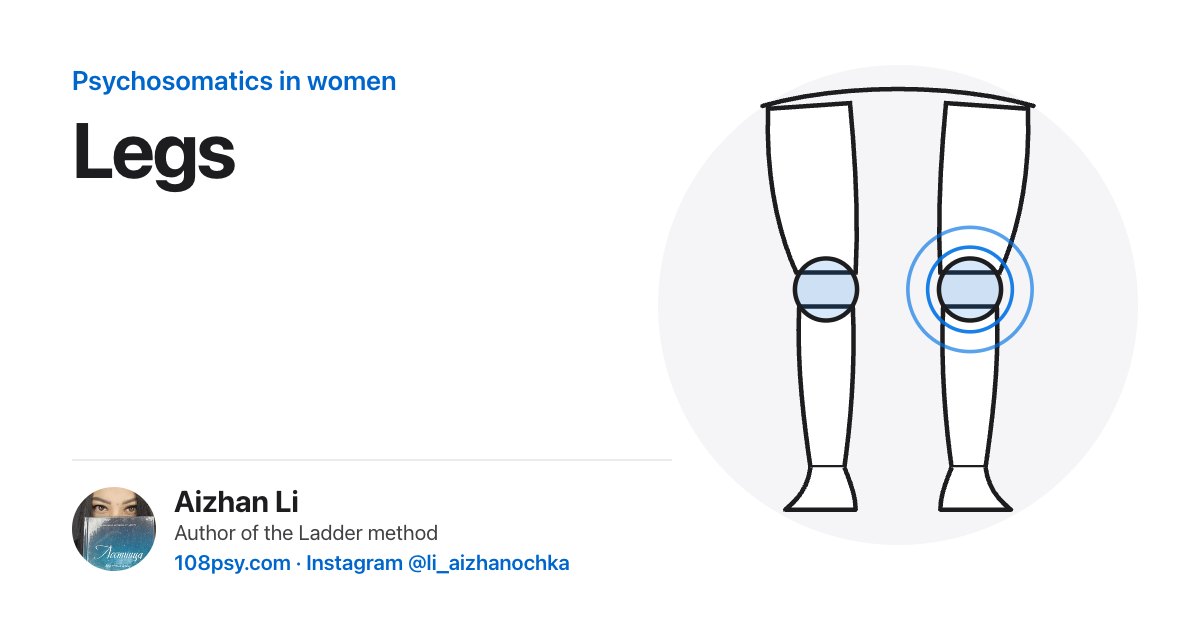
The hips are linked to the feeling “I can’t take this.” The knees, to recognition: you try as hard as you can, but no one notices, and you start believing you’re not good enough yourself. The feet and ankles, to the place where you stand: “I don’t belong here,” “I wish I were anywhere but here,” next to someone who’s hard to bear.
Heavy legs and vein problems are described as “weights on your legs.” Obligations and other people’s burdens keep you in place, and you no longer even remember your own plans. Psychosomatics helps you see what exactly is holding you, and take back the right to go your own way.
What it is
When women come in about their legs, it’s usually with a few complaints: heaviness and tiredness by evening, swelling, spider veins and bulging veins, calf cramps, pain in the knees and hips. These have different causes, so they need different doctors.
Heaviness, swelling, aching pain and night cramps are often linked to the veins. According to the Russian Ministry of Health clinical guidelines on varicose veins (2024), one Russian study found signs of vein disease in 69% of adults and varicose veins in 29%. In a large international study of people with vein disease, 68% were women. The risk goes up with family history, age, extra weight, long hours on your feet, pregnancies and menopause.
Pain in the knee or groin that gets worse with walking and toward the end of the day, with the joint stiff for a short while in the morning, can be osteoarthritis. According to the Russian Ministry of Health clinical guidelines on knee osteoarthritis (2024), 13% of adults in Russia have osteoarthritis of the knee or hip, and women develop it 1.2–1.7 times more often than men. The clinical protocol of the Ministry of Health of Kazakhstan (2022) also names a lack of estrogen after menopause among the causes.
Leg cramps are usually harmless and last from a few seconds to 10 minutes, says the UK’s National Health Service (NHS). They happen more often late in pregnancy, when you’re low on fluids, and with some medicines. A separate danger is a blood clot in a deep vein: when one leg suddenly swells and hurts, it gets checked right away.
How it shows up
- Heavy, tired legs by evening
- Swelling in the feet and lower legs
- Spider veins, bulging or twisted veins
- Calf cramps, often at night
- Knee or groin pain when walking, stiffness in the morning
- Tingling, burning or numbness in the legs
Veins are checked by a phlebologist or vascular surgeon with an ultrasound, joints by a rheumatologist or orthopedic specialist. You can start with a general practitioner.
Frequently asked questions
Can stress cause leg pain?
Leg pain is checked by a doctor first: veins, joints or muscles can be behind it. Many women notice their legs start hurting during a hard time, when they’re holding on with the last of their strength. That’s what psychosomatics looks at: what you’re carrying right now, and where you can’t walk away from.
What does knee pain mean in psychosomatics?
The knees are linked to recognition. You try hard, but no one praises or notices you, and the feeling “I’m not good enough” grows inside. If your knee hurts for a long time, have a rheumatologist or orthopedic specialist look at it, and psychosomatics will help you figure out whose approval you’re waiting for so badly.
Are varicose veins psychosomatic?
Varicose veins are a vein disease. The tendency often runs in families, and the risk grows with age, extra weight, pregnancies and long hours on your feet. A phlebologist treats them. Psychosomatics adds its own view: heavy legs are linked to a burden that keeps you in place and doesn’t let you live by your own plans.
Sources
- Клинический протокол «Варикозное расширение вен нижних конечностей». Министерство здравоохранения Республики Казахстан, 2015
- Клинический протокол «Остеоартроз». Министерство здравоохранения Республики Казахстан, 2022
- Клинический протокол «Венозные тромбозы и тромбофлебиты, посттромбофлебитический синдром». Министерство здравоохранения Республики Казахстан, 2018
- Клинические рекомендации «Варикозное расширение вен нижних конечностей». Минздрав России, Ассоциация флебологов России, Ассоциация сердечно-сосудистых хирургов России, 2024
- Клинические рекомендации «Гонартроз». Минздрав России, Ассоциация ревматологов России, Ассоциация травматологов-ортопедов России, 2024
- Клинические рекомендации «Тромбоз глубоких вен конечностей». Минздрав России, Ассоциация флебологов России и др., 2025
- Leg cramps. Национальная служба здравоохранения Великобритании (NHS), 2023
- DVT (deep vein thrombosis). Национальная служба здравоохранения Великобритании (NHS), 2026
See what is holding you back.
In 10 minutes, the Ladder shows past events, other people’s words and your fears on one map.
Take the free diagnosticFree · 10 minutes · on your phoneRelated topics
Psychosomatics does not replace tests and treatment. Only a doctor can make a diagnosis.