Thyroid psychosomatics
Psychosomatics does not explain why the thyroid gets ill. Hypothyroidism, hyperthyroidism and nodules are found with a TSH blood test and an ultrasound, and an endocrinologist treats them. If you feel tired for no reason, are always cold or get hot flashes, and your heart beats too fast or too slow, get tested first. The Ladder method adds questions for yourself about the pace of your life and the feeling “I can't keep up.”

Updated
When to see a doctor
Book a doctor’s appointment if you notice:
- Tiredness and sleepiness, or the opposite: anxiety and poor sleep
- Your weight changes for no clear reason
- You're always cold, or the opposite: you get hot flashes
- Dry skin, brittle nails, hair loss
- Your heart beats too fast or too slow
- A feeling of a lump or pressure in your throat
An endocrinologist makes the diagnosis based on blood tests and an ultrasound.
What medicine knows
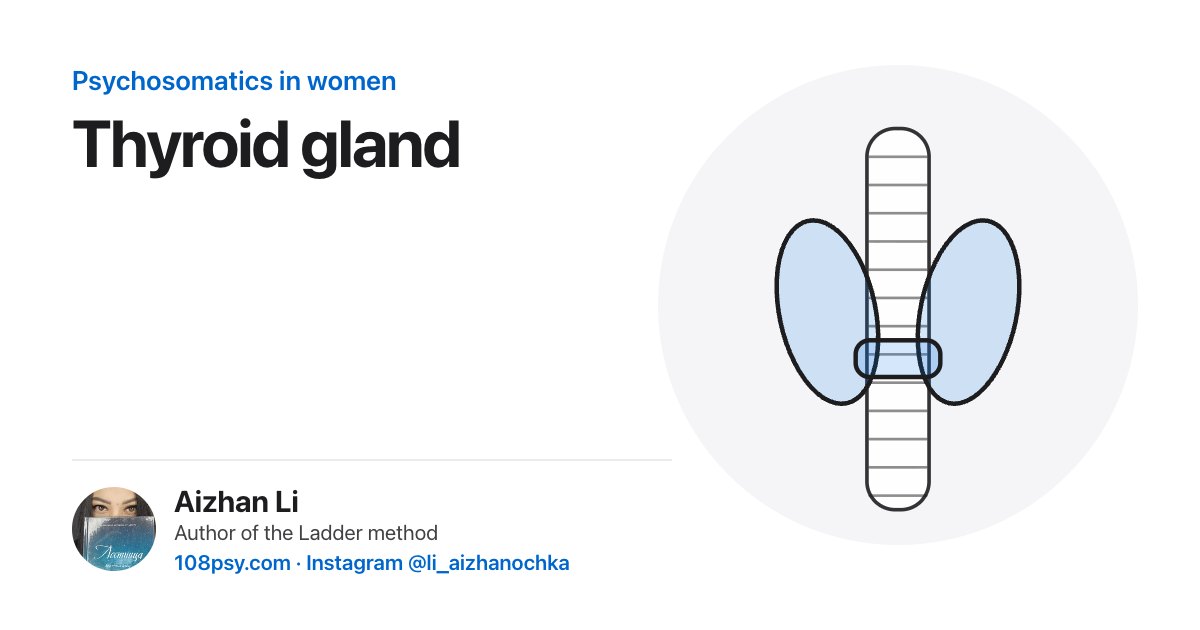
The thyroid sits at the front of your neck and is shaped like a butterfly. It makes hormones that control how fast your body uses energy: metabolism, heartbeat, warmth and mood depend on them.
Three conditions are the most common. Hypothyroidism, when there are too few hormones and everything slows down. Hyperthyroidism, when there are too many and the body wears itself out. And nodules, lumps in the thyroid tissue, most of which are benign.
Women have thyroid problems several times more often than men, especially after pregnancy and closer to menopause. According to the Russian Ministry of Health clinical guidelines (2024), goiter, meaning an enlarged thyroid, develops 2–3 times more often in women. Graves' disease, one of the most common causes of hyperthyroidism, affects about 3% of women over their lifetime and only 0.5% of men.
Most thyroid conditions come from autoimmune processes, when the immune system attacks the gland itself, or from iodine deficiency. The Russian Ministry of Health clinical guidelines on Graves' disease (2025) list smoking, pregnancy and stress among the factors that predispose to it.
Thyroid function is checked with a blood test for TSH and thyroid hormones, and nodules show up on an ultrasound.
Sources
- Клинический протокол «Тиреотоксикоз у взрослых». Министерство здравоохранения Республики Казахстан, 2017
- Клинический протокол «Узловой зоб». Министерство здравоохранения Республики Казахстан, 2016
- Клинические рекомендации «Заболевания и состояния, связанные с дефицитом йода». Минздрав России, Российская ассоциация эндокринологов, 2024
- Клинические рекомендации «Тиреотоксикоз с диффузным зобом (болезнь Грейвса), узловым/многоузловым зобом». Минздрав России, Российская ассоциация эндокринологов, 2025
In the Ladder method
In the Ladder method, the thyroid is a way to look at the pace of your life. It is not an explanation of the illness but a question for yourself: where are you always “not keeping up,” and who set that speed for you?
Often there are hurtful words behind the feeling “I can't keep up”: “you're too slow,” “you don't understand anything.” On the ladder they become a step between you and your goal, and you can look at each one on its own.
This pace keeps some women anxious and rushing, and drains others of energy. Understanding it is useful with any diagnosis, while tests and treatment stay with your endocrinologist.
These are questions for reflection, not an explanation of what causes the condition and not a treatment.
Frequently asked questions
Can stress cause thyroid problems?
The Russian Ministry of Health clinical guidelines name stress as one of the factors that predispose to Graves' disease, along with smoking and pregnancy. But an endocrinologist looks for the cause of a thyroid condition in blood tests and on an ultrasound: most often it is an autoimmune process or iodine deficiency. Emotions don't replace a check-up.
What does the thyroid mean in psychosomatics?
The condition has no proven “meaning.” In the Ladder method, the thyroid is a reason to look at the pace of your life and the feeling “I can't keep up.” Often there are someone else's words about you being slow behind it, pushing you from the inside for years.
If I take thyroid hormones, do I still need psychosomatics?
Hormones are prescribed by an endocrinologist, and you can only change the dose or stop them together with your doctor. The Ladder method's questions don't treat the thyroid; they help you understand what's driving you so hard. One doesn't get in the way of the other.
See what is holding you back.
In 10 minutes, the Ladder shows past events, other people’s words and your fears on one map.
Take the free diagnosticFree · 10 minutes · on your phoneRelated topics
Psychosomatics does not replace tests and treatment. Only a doctor can make a diagnosis.