Lower back psychosomatics
Lower back pain is one of the most common reasons people see a doctor. Most often it isn’t dangerous and goes away within a few weeks.

Updated
What psychosomatics says
In psychosomatics, the lower back is support. The whole body rests on it, and it’s linked to the feeling “I’m coping” or “I can’t keep this up anymore.” When the load is too heavy and there’s no one to lean on, your back starts to hurt.
Often behind it is the feeling that you’re not good enough. Your mother-in-law doubts you’re a good mother. At work they make it clear you can’t handle it. A man left, and you decided it was your fault. Things like this hit the very foundation, who you are.
Sometimes the back starts hurting right after a hard conversation or an unpleasant thought. Try to remember what happened just before the pain appeared. Psychosomatics helps you see what load you’re carrying alone, and whose words are still telling you that you won’t cope.
What it is
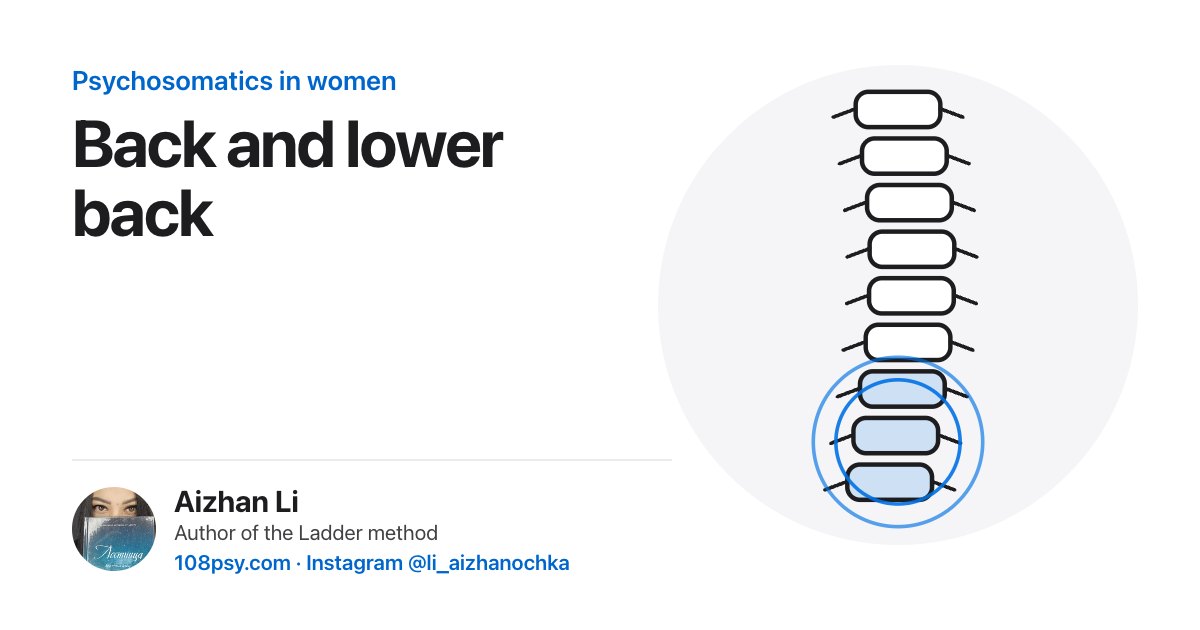
Doctors call the area between the lowest ribs and the folds of the buttocks the lower back. Pain there usually comes from the muscles, ligaments, spinal joints and the discs between the vertebrae, and often no single exact cause can be found. This is called nonspecific pain. According to the Russian Ministry of Health clinical guidelines (2023), it accounts for 90–95% of cases of acute lower back pain.
According to the World Health Organization (2023), 619 million people worldwide had lower back pain in 2020. It’s the leading cause of disability on the planet. Women have it more often than men.
Pain is considered acute for up to 4 weeks, and chronic if it lasts 12 weeks or longer. According to the clinical protocol of the Ministry of Health of Kazakhstan (2025), acute pain usually goes away in 2–3 weeks, and it’s better not to stay in bed for long. According to the Russian Ministry of Health guidelines, in 90% of cases it goes away within 6 weeks, but in one person out of three it comes back within a year.
If the pain spreads to the buttock and down the back of the leg to the foot, with tingling and numbness, it’s sciatica: the sciatic nerve is irritated. Its most common cause is a herniated disc, when the soft cushion between the vertebrae bulges out and presses on the nerve. During pregnancy the ligaments soften to get ready for birth, the load on the lower back and pelvis grows, and the back can hurt too. That’s how the UK’s National Health Service (NHS) describes it.
How it shows up
- An aching lower back that gets worse when you move, walk or hold an awkward position
- The pain eases when you rest
- It’s hard to straighten up after bending, lifting something heavy or sitting for a long time
- The pain spreads to the buttock and down the back of the leg
- Tingling, burning or numbness in the leg and foot
A general practitioner or neurologist examines you. For ordinary acute pain without warning signs, scans usually aren’t needed: the protocol of the Ministry of Health of Kazakhstan advises against them in the first 4 weeks for people aged 18 to 50.
Frequently asked questions
Can stress cause lower back pain?
The pain itself comes from muscles, ligaments, joints and discs, and the first time it happens, a doctor rules out dangerous causes. But according to the Russian Ministry of Health clinical guidelines, pain is more likely to drag on with anxiety, depression, family problems and dissatisfaction with work. Psychosomatics looks at what tension you’re carrying in your body.
What does lower back pain mean in psychosomatics?
The lower back is linked to support and the feeling that you’re coping. Pain shows up when the load feels too heavy, or when someone made you doubt yourself as a mother, wife or worker. There’s no weakness in that. More likely, you’ve needed support for a long time.
Can psychosomatic work heal a herniated disc or sciatica?
No one can promise that. A neurologist chooses the treatment, and numbness in the groin or weakness in the legs needs urgent help. According to the protocol of the Ministry of Health of Kazakhstan, for chronic lower back pain, psychological methods together with therapeutic exercise are considered among the most effective. Psychosomatics goes alongside treatment and helps you put down the load that’s been pressing on you.
Sources
- Клинический протокол «Скелетно-мышечная (неспецифическая) боль в нижней части спины». Министерство здравоохранения Республики Казахстан, 2025
- Клинические рекомендации «Скелетно-мышечные (неспецифические) боли в нижней части спины». Минздрав России, 2023
- Low back pain. Fact sheet. Всемирная организация здравоохранения, 2023
- Sciatica. Национальная служба здравоохранения Великобритании (NHS), 2024
- Back pain in pregnancy. Национальная служба здравоохранения Великобритании (NHS), 2024
See what is holding you back.
In 10 minutes, the Ladder shows past events, other people’s words and your fears on one map.
Take the free diagnosticFree · 10 minutes · on your phoneRelated topics
Psychosomatics does not replace tests and treatment. Only a doctor can make a diagnosis.