Psychosomatics of endometrial polyps
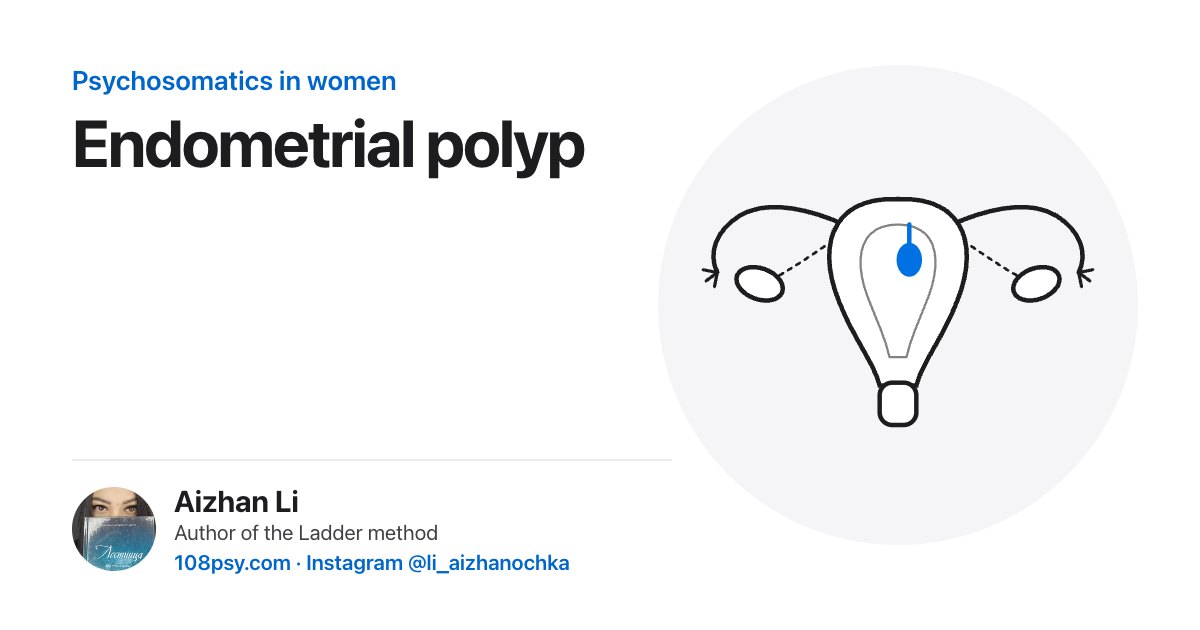
An endometrial polyp is an overgrowth of the inner lining of the womb, on a stalk or a broad base. The vast majority of polyps are benign, and many cause no symptoms and are found on an ultrasound. See a doctor first: a gynaecologist will decide whether it needs removing during a hysteroscopy, and a removed polyp is always sent to the lab. The Ladder method adds questions about what you allow yourself in intimacy and femininity.

Updated
When to see a doctor
Book a doctor’s appointment if you notice:
- Spotting between periods
- Periods have become longer or heavier
- Unusual vaginal discharge
- Bleeding while taking hormonal pills
- Bleeding after the menopause
- You cannot get pregnant
Start with a gynaecologist: they will arrange a pelvic ultrasound and decide whether you need a hysteroscopy. If the polyp is removed, discuss the histology result with your doctor. Hormone treatment is only prescribed based on the histology.
What medicine knows
The Kazakhstan Ministry of Health clinical protocol “Endometrial polyp” describes polyps as local overgrowths of the glands of the endometrium, the inner lining of the womb. They sit on a thin stalk or a broad base and range from a few millimetres to 3 to 4 centimetres. The vast majority of polyps are benign.
According to the protocol, polyps are found in 7.8 to 34.9% of women, depending on the group studied. About 25% of polyps disappear on their own, and small ones under 10 mm do so more often than large ones. A Chelsea and Westminster Hospital leaflet (NHS, 2025) lists conditions in which polyps are more common: a raised body mass index, diabetes, high blood pressure, PCOS and taking tamoxifen.
Most polyps cause no symptoms. When there are signs, they are long or heavy periods, bleeding between periods, bleeding after the menopause, problems with pregnancy and infertility (protocol).
A polyp can be seen on an ultrasound, and more precisely at hysteroscopy, when a doctor looks inside the womb with a thin camera. The protocol advises removing polyps that cause symptoms, as well as those over 1 cm, multiple polyps or polyps in women with infertility, and after the menopause all polyps are removed. Removal takes a few minutes during the hysteroscopy, and the tissue is always examined under a microscope (histology).
The NHS leaflet says that after removal symptoms improve in 75 to 100% of women. A polyp can grow back, but further treatment is usually not needed.
In the Ladder method
In the Ladder method a polyp is not explained by emotions: medicine does not fully know where polyps come from, and a gynaecologist treats them. The questions for yourself here are about how you live in your woman's body.
In psychosomatics the womb is linked to intimacy, relationships and having children. Sometimes behind years of putting up with things there is hurt towards a partner, a feeling of being used, or intimacy you do not want but agree to. It is hard to talk about this even with yourself.
On the ladder this shows up as steps made of “I have to put up with it” and “everyone lives like this”. You can look at them calmly, without guilt. The decision to remove a polyp stays with your doctor.
These are questions for reflection, not an explanation of what causes the condition and not a treatment.
Frequently asked questions
What causes an endometrial polyp?
The exact cause is unknown. The NHS leaflet lists conditions in which polyps are more common: higher weight, diabetes, high blood pressure, PCOS, taking tamoxifen. The Kazakhstan Ministry of Health protocol says about a quarter of polyps disappear on their own, especially small ones. Psychosomatics does not explain the cause; it is about questions for yourself.
Will a polyp come back after removal?
It can, the NHS leaflet allows for that, but further treatment is usually not needed. After removal symptoms improve in 75 to 100% of women. Your gynaecologist arranges the check after removal, and under the protocol it is done with an ultrasound.
Does a polyp stop you getting pregnant?
The Kazakhstan Ministry of Health protocol names problems with pregnancy and infertility among the signs of a polyp and advises removing polyps in infertility even without other symptoms. If you are planning a pregnancy, discuss this with your gynaecologist in advance.
See what is holding you back.
In 10 minutes, the Ladder shows past events, other people’s words and your fears on one map.
Take the free diagnosticFree · 10 minutes · on your phoneRelated topics
Psychosomatics does not replace tests and treatment. Only a doctor can make a diagnosis.