Uterus psychosomatics
The uterus is the organ where a baby grows. In psychosomatics, it's linked to everything about motherhood, intimacy and a woman's path in life.

Updated
What psychosomatics says
In psychosomatics, the uterus is linked to motherhood and your role as a woman. Do I want children, can I have them, do I allow myself to.
This also covers intimacy and how you feel with a man: desired or used, protected or humiliated.
Family stories often live in this theme too: how your mom and grandmother gave birth, what happened to the children. Psychosomatics helps you separate them from your own life.
What it is
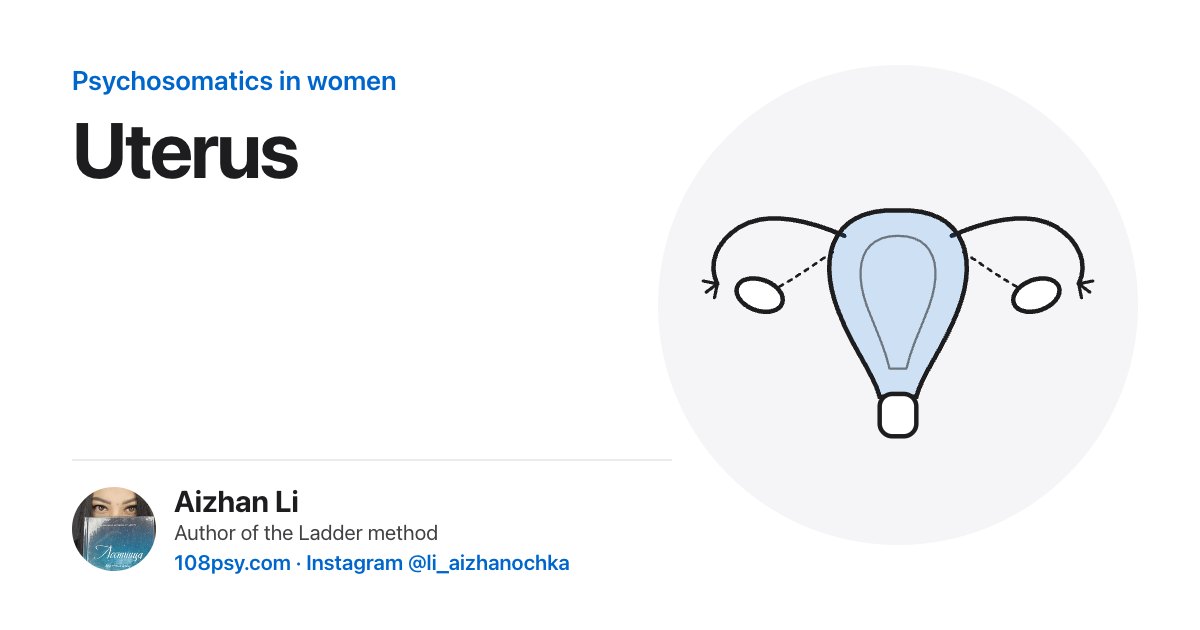
The uterus is a muscular organ in the lower belly. Its inner lining, the endometrium, grows and renews every month, and its muscular wall contracts during periods and childbirth.
The most common conditions women face are fibroids, endometriosis and adenomyosis, endometrial hyperplasia, changes in the cervix and cycle problems.
These conditions are common. According to the Russian Ministry of Health clinical guidelines (2024), fibroids occur in almost 70% of women of reproductive age, and endometriosis in about one in ten. The World Health Organization estimates that 190 million women worldwide have endometriosis.
Many of these conditions cause no symptoms for years and are only found during a checkup or ultrasound. That's why doctors advise seeing a gynecologist once a year. The cervix is checked separately: in Kazakhstan, under the national screening program, women aged 30 to 74 get a free cytology smear every 4 years.
How it shows up
- Heavy or painful periods
- Spotting between periods
- Dull, pulling pain in the lower belly
- Pain during sex
- Trouble getting pregnant
A gynecologist makes the diagnosis based on an exam and ultrasound.
Frequently asked questions
What does the uterus mean in psychosomatics?
The uterus is linked to motherhood and your role as a woman: do I want children, can I have them, do I allow myself to. It also covers intimacy and how you feel with a man. Family stories often live in this theme too.
How common are uterine problems?
Very common. According to the Russian Ministry of Health clinical guidelines (2024), fibroids occur in almost 70% of women of reproductive age, and endometriosis in about one in ten. Many conditions cause no symptoms, which is why doctors advise seeing a gynecologist once a year.
Do uterus problems run in families?
Fibroids and endometriosis are more common in women whose mothers and sisters have had them, so it's worth telling your gynecologist about your family history. Psychosomatics looks at family in its own way: which stories about pregnancy and birth you've inherited and how they shape your life.
Sources
- Клинический протокол «Миома матки». Министерство здравоохранения Республики Казахстан, 2016
- Клинический протокол «Генитальный эндометриоз». Министерство здравоохранения Республики Казахстан, 2019
- Приказ Министерства здравоохранения Республики Казахстан № ҚР ДСМ-174/2020 «Об утверждении целевых групп лиц, подлежащих скрининговым исследованиям…» (действующая редакция)
- Клинические рекомендации «Миома матки». Минздрав России, Российское общество акушеров-гинекологов, 2024
- Клинические рекомендации «Эндометриоз». Минздрав России, Российское общество акушеров-гинекологов, 2024
- Endometriosis. Fact sheet. Всемирная организация здравоохранения, 2025
See what is holding you back.
In 10 minutes, the Ladder shows past events, other people’s words and your fears on one map.
Take the free diagnosticFree · 10 minutes · on your phoneRelated topics
Psychosomatics does not replace tests and treatment. Only a doctor can make a diagnosis.