Psychosomatics of endometrial hyperplasia
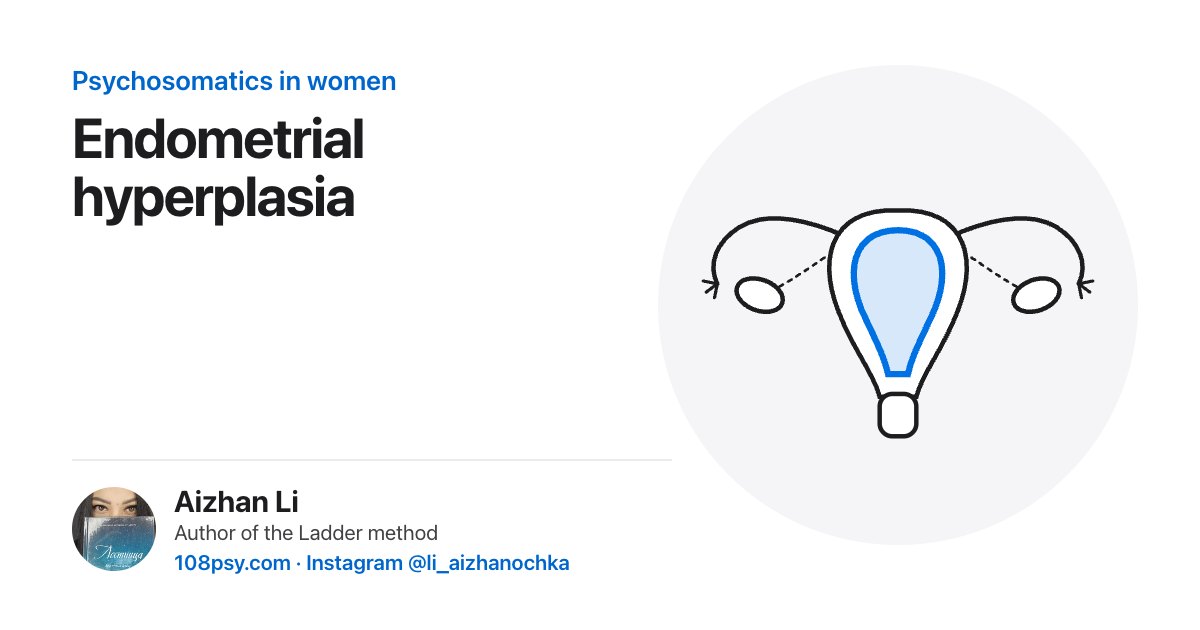
In hyperplasia, the inner lining of the uterus, the endometrium, becomes thicker than it should be. This is usually linked to too much estrogen.

Updated
What psychosomatics says
In psychosomatics, the endometrium is linked to intimacy and a woman's dignity. To the feeling that you're not respected as a woman and that intimacy has become a duty.
Sometimes you have almost no desire, but your partner wants it, and you agree so you don't hurt him. Tension builds up inside, and nobody knows about it.
Psychosomatics helps you see where you give up your own desires for someone else's.
What it is
The endometrium grows under the influence of estrogen and renews itself with each period. When there's a lot of estrogen and too little progesterone, it thickens.
This happens with ovulation problems, excess weight, polycystic ovaries and before menopause. Hyperplasia shows up on ultrasound and is confirmed with a tissue test.
According to the Russian Ministry of Health clinical guidelines (2025), hyperplasia is most often found at ages 50–54: in about 4 in 1000 women per year. It's rare before age 30.
Some forms of hyperplasia need monitoring because they can turn malignant. That's why the treatment plan should always be discussed with a gynecologist.
How it shows up
- Heavy, long periods
- Spotting between periods
- Bleeding after menopause
- Often no signs at all
A gynecologist makes the diagnosis based on ultrasound and an endometrial tissue test.
Frequently asked questions
What causes endometrial hyperplasia?
Usually too much estrogen and not enough progesterone. This happens with ovulation problems, excess weight, polycystic ovaries and before menopause.
What does endometrial hyperplasia mean in psychosomatics?
The endometrium is linked to intimacy and a woman's dignity. To the feeling that you're not respected as a woman and that intimacy has become a duty. Tension builds up inside, and nobody knows about it.
Is endometrial hyperplasia dangerous?
Some forms need monitoring because they can turn malignant. That's why hyperplasia is confirmed with a tissue test, and the treatment plan is made by a gynecologist.
Sources
See what is holding you back.
In 10 minutes, the Ladder shows past events, other people’s words and your fears on one map.
Take the free diagnosticFree · 10 minutes · on your phoneRelated topics
Psychosomatics does not replace tests and treatment. Only a doctor can make a diagnosis.