Ovarian cyst psychosomatics
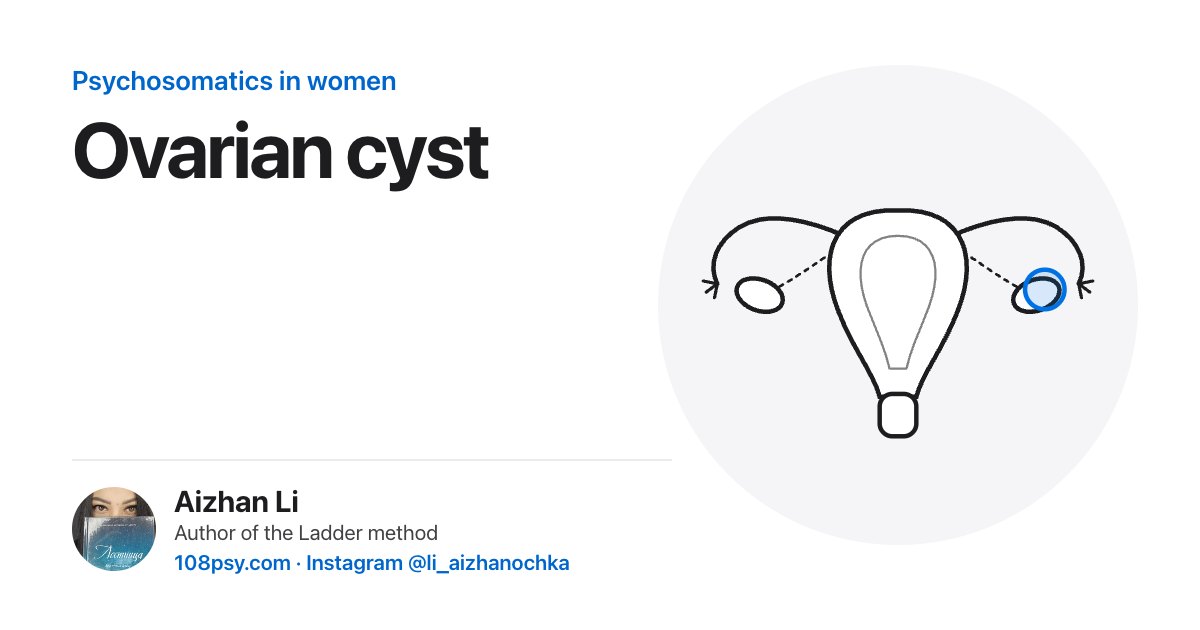
An ovarian cyst is a fluid-filled sac in or on an ovary. Most often it forms during your cycle and goes away on its own.

Updated
What psychosomatics says
In psychosomatics, an ovarian cyst is linked to losing someone close or the fear of losing them. It could be a death, a divorce, a move, a child who has moved away, or even a pet.
Sometimes the loss isn't visible from the outside. The person is still there but has drifted away emotionally: your mom, a friend, your husband. Inside, it feels like a loss.
Psychosomatics invites you to look at which loss you haven't fully lived through yet, and what's stopping you from letting it go.
What it is
Most cysts are functional. They form from a follicle or the corpus luteum. According to the Russian Ministry of Health clinical guidelines (2025), these cysts, if smaller than 5 cm, usually go away on their own within 2–3 months.
There are other cysts too, such as endometriomas or dermoid cysts. They don't go away on their own, and a doctor keeps an eye on them.
A cyst shows up on an ultrasound. It's often found by chance, when nothing is bothering you. If a cyst is simple, has a single chamber, is smaller than 5 cm, and causes no symptoms, the doctor usually suggests repeating the ultrasound in 2–3 months. The risk that such a cyst is malignant is less than 1%.
How it shows up
- Often there are no signs at all
- Heaviness or pain on one side of your lower belly
- Cycle irregularities
- Pain during sex
A gynecologist makes the diagnosis with an ultrasound.
Frequently asked questions
Is an ovarian cyst dangerous?
Most often, a cyst forms during your cycle and goes away on its own within a few months. But there are different kinds of cysts, so a gynecologist monitors yours with ultrasound. Sudden pain in your lower belly is a reason to see a doctor right away.
What is the psychosomatic meaning of an ovarian cyst?
A cyst is linked to losing someone close or the fear of losing them: a death, a divorce, a move, a child who has moved away. Sometimes the loss isn't visible from the outside: the person is still there but has drifted away emotionally. Inside, it feels like a loss.
Can an ovarian cyst go away after working through emotions?
Many cysts go away on their own, so you can't directly link the two. Psychosomatics helps you live through a loss that has stayed inside you. A gynecologist still keeps monitoring the cyst.
Sources
See what is holding you back.
In 10 minutes, the Ladder shows past events, other people’s words and your fears on one map.
Take the free diagnosticFree · 10 minutes · on your phoneRelated topics
Psychosomatics does not replace tests and treatment. Only a doctor can make a diagnosis.