Hypothyroidism psychosomatics
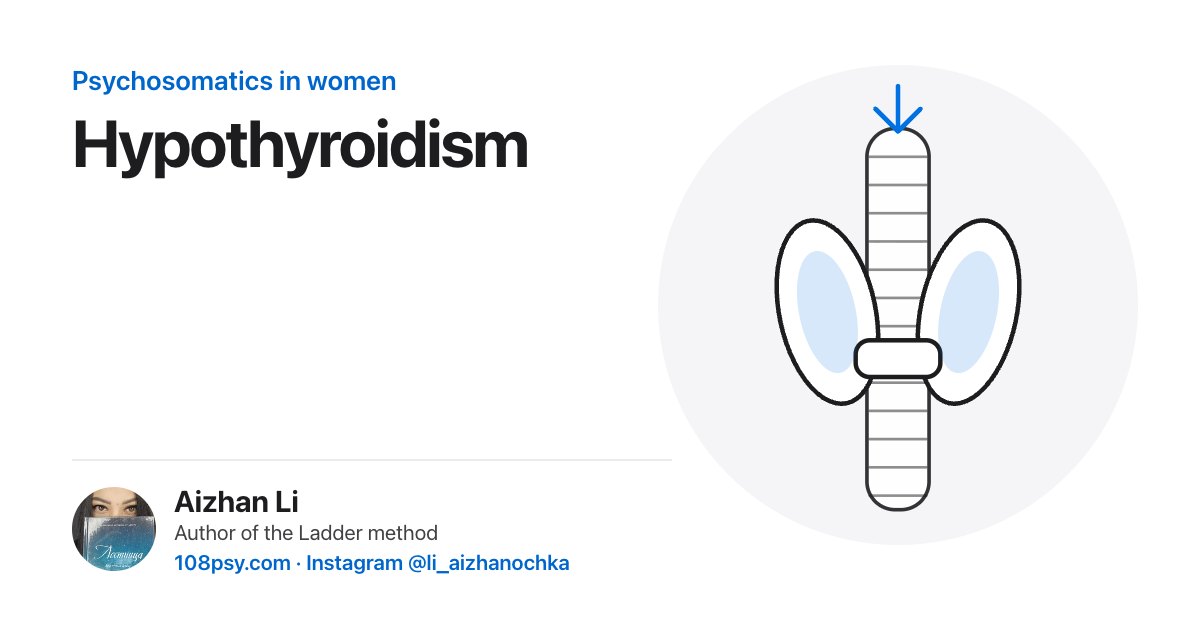
With hypothyroidism, the thyroid makes too few hormones, and everything in the body slows down: metabolism, thoughts, mood.

Updated
What psychosomatics says
In psychosomatics, hypothyroidism is often described as the state when your strength runs out after a long race. For years you ran, kept up for everyone, and your body switched to power-saving mode.
Inside, you may hear “I won't make it anyway,” “I'll never manage.” Then it feels easier to slow down completely than to lose again.
Psychosomatics helps you understand which race wore you out like this, and who set it up for you.
What it is
The most common cause of hypothyroidism is autoimmune thyroiditis, also called Hashimoto's. The immune system gradually damages the thyroid.
According to the Russian Ministry of Health clinical guidelines (2024), almost 5 in 100 people have hypothyroidism. Most often it's a mild, hidden form: TSH is already high, while the T4 hormone is still normal. Every year, hypothyroidism appears for the first time in about 3–4 out of 1,000 women.
Women get hypothyroidism much more often than men, and more often after age 60. That's how the US National Institutes of Health explains it. It's detected with a blood test for TSH.
If hypothyroidism is confirmed, an endocrinologist will choose a hormone for you. It's important to take it exactly as your doctor prescribed and not to stop on your own.
How it shows up
- Tiredness and sleepiness, even after sleeping
- You're always cold
- You gain weight even though you eat the same as before
- Dry skin, hair loss
- Low mood, forgetfulness
- Cycle irregularities
An endocrinologist makes the diagnosis based on a blood test for TSH and thyroid hormones.
Frequently asked questions
Can stress cause hypothyroidism?
Most often, hypothyroidism is linked to autoimmune thyroiditis, when the immune system attacks the thyroid. It's diagnosed with a TSH test. In psychosomatics, it's described as power-saving mode after a long race.
Why do you have no energy with hypothyroidism?
There are too few thyroid hormones, and everything in the body slows down: metabolism, thoughts, mood. That's where the tiredness, sleepiness, and feeling cold come from. Psychosomatics also asks: which race wore you out like this, and who set it up?
Can I stop taking thyroid hormones if I work through the cause?
No. Only an endocrinologist prescribes and changes the dose, based on your tests. Hormones replace what your body is missing, and the inner work helps you live at your own pace.
Sources
See what is holding you back.
In 10 minutes, the Ladder shows past events, other people’s words and your fears on one map.
Take the free diagnosticFree · 10 minutes · on your phoneRelated topics
Psychosomatics does not replace tests and treatment. Only a doctor can make a diagnosis.