Psychosomatics of a runny nose and sinusitis
Your nose is blocked, there’s pressure under your eyes and in your forehead, you can’t smell anything. That’s often what sinusitis looks like.

Updated
What psychosomatics says
In psychosomatics, the nose is linked to smell, literally and figuratively. A runny nose and sinusitis are described through the feeling “I can’t stand it,” “I’m fed up with this.” A person, a situation, an atmosphere that makes you feel bad, and you can’t leave.
It could be a coworker who wears you down, fights with your parents every time you visit, a job where the boss is driving things into the ground and you have to watch.
Another theme is instinct. You can’t “sniff out” what’s ahead and live with anxious forebodings: a move, a new boss, the unknown after a change. Psychosomatics helps you name what you’re fed up with and find what you can do about it.
What it is
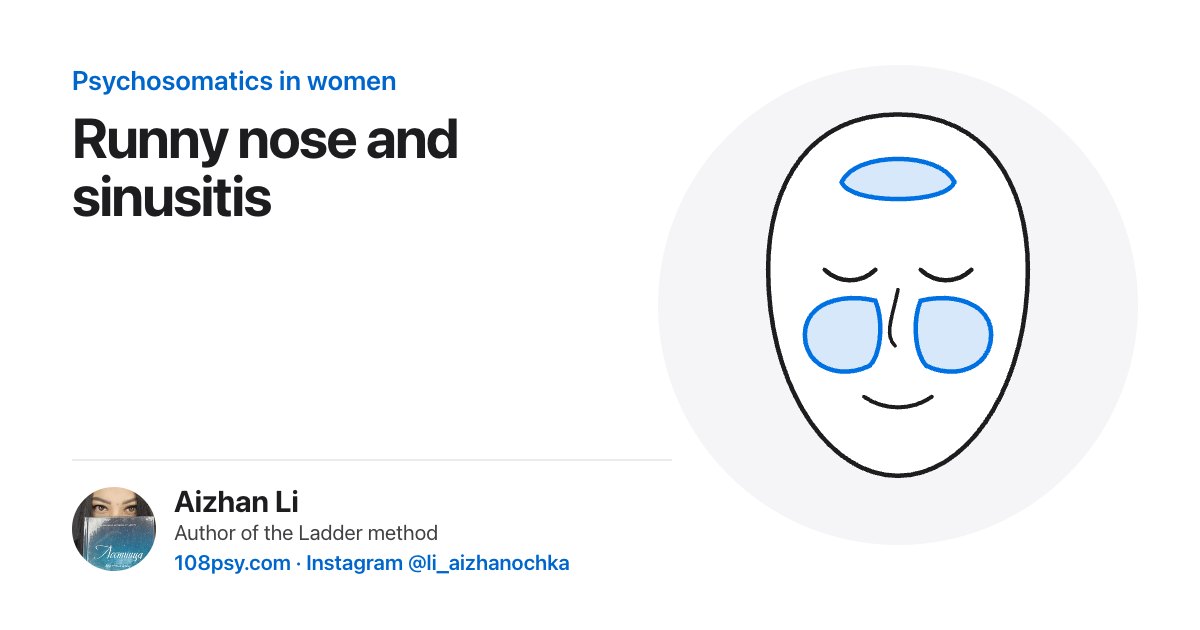
Sinusitis is an inflammation of the sinuses: small spaces behind your cheekbones and forehead that connect to the nose. Inflammation of the maxillary sinuses under the eyes is called maxillary sinusitis, of the forehead sinuses frontal sinusitis. That’s how the clinical protocol of the Kazakhstan Ministry of Health (2017) divides them.
The UK’s National Health Service (NHS) says sinusitis often starts after a cold or flu and usually clears up on its own within 4 weeks. It’s usually caused by a virus, not bacteria, so antibiotics are rarely needed.
The Kazakhstan Ministry of Health protocol names the main complaints: it’s hard to breathe through your nose or it’s blocked, there’s pus-like discharge, and it hurts where the sinus is inflamed: under the eyes, above the eyebrows, at the bridge of the nose. Sometimes sinusitis starts from a bad upper tooth, and then you need a dentist too.
If your nose has been running for years or gets blocked in spring or around a cat, it may be allergic rhinitis. The Kazakhstan Ministry of Health has a separate protocol for it (2023).
How it shows up
- A blocked nose, you breathe through your mouth
- Pain and pressure under your eyes, in your forehead or at the bridge of your nose
- Yellow or green mucus from your nose
- Your sense of smell is gone or weaker
- A headache, your upper teeth ache
- Bad breath, a cough, snoring at night
Start with a general practitioner. If sinusitis doesn’t go away or keeps coming back, you need an ear, nose and throat (ENT) doctor. The NHS advises seeing a doctor if you’re not better after 3 weeks of treating it at home.
Frequently asked questions
Can sinusitis come from nerves?
Sinusitis most often starts after a cold or flu and is usually caused by a virus. The NHS says it often clears up on its own within 4 weeks. Psychosomatics adds its own view: what was happening in your life when your nose started getting blocked again and again.
What does a runny nose mean in psychosomatics?
The nose is linked to smell in a figurative sense: “I can’t stand it,” “I’m fed up with this.” Another theme is anxiety when you can’t “sniff out” what lies ahead.
If an ENT doctor prescribed treatment, do I need psychosomatics?
A doctor prescribes treatment, and it’s important to finish it, especially if sinusitis keeps coming back. Psychosomatics goes alongside: it helps you see what you’re so fed up with. One doesn’t get in the way of the other.
Sources
- Клинический протокол «Острый и хронический синусит (у взрослых и у детей)». Министерство здравоохранения Республики Казахстан, 2017
- Клинический протокол «Аллергический ринит». Министерство здравоохранения Республики Казахстан, 2023
- Sinusitis (sinus infection). Национальная служба здравоохранения Великобритании (NHS), 2024
See what is holding you back.
In 10 minutes, the Ladder shows past events, other people’s words and your fears on one map.
Take the free diagnosticFree · 10 minutes · on your phoneRelated topics
Psychosomatics does not replace tests and treatment. Only a doctor can make a diagnosis.